
In today’s digital world, businesses want their websites to appear at the top of search engine results when people search for products, services, or information. Search engines like Google receive billions of searches every day, making them one of the most powerful platforms for reaching potential customers. Two of the most common strategies used to improve online visibility are Search Engine Optimization (SEO) and Search Engine Marketing (SEM).
Although SEO and SEM have the same goal—bringing more visitors to a website—they work in different ways. Understanding the difference between them helps businesses choose the right strategy based on their goals, budget, and timeline.
What is SEO?
SEO (Search Engine Optimization) is the process of improving a website so that it appears higher in the organic (unpaid) search results of search engines like Google. The main objective of SEO is to attract visitors naturally without paying for every click.
SEO focuses on making a website useful, relevant, and easy for both users and search engines to understand.
Key Elements of SEO
1. Keyword Research
- Finding the words and phrases people search for.
- Example: “best digital marketing course” or “SEO tips for beginners.”
2. On-Page SEO
- Optimizing title tags and meta descriptions.
- Using keywords naturally in content.
- Adding headings (H1, H2, H3).
- Optimizing images with alt text.
- Improving internal linking.
3. Off-Page SEO
- Building backlinks from trusted websites.
- Increasing brand mentions.
- Guest blogging and influencer outreach.
4. Technical SEO
- Improving website speed.
- Making the website mobile-friendly.
- Using HTTPS for security.
- Creating XML sitemaps.
- Fixing broken links and crawl errors.
Advantages of SEO
- Free organic traffic.
- Builds long-term credibility and trust.
- Provides sustainable website growth.
- Better user experience.
- Higher return on investment (ROI) over time.
Disadvantages of SEO
- Results take time (usually several months).
- Requires continuous optimization.
- Search engine algorithms change regularly.
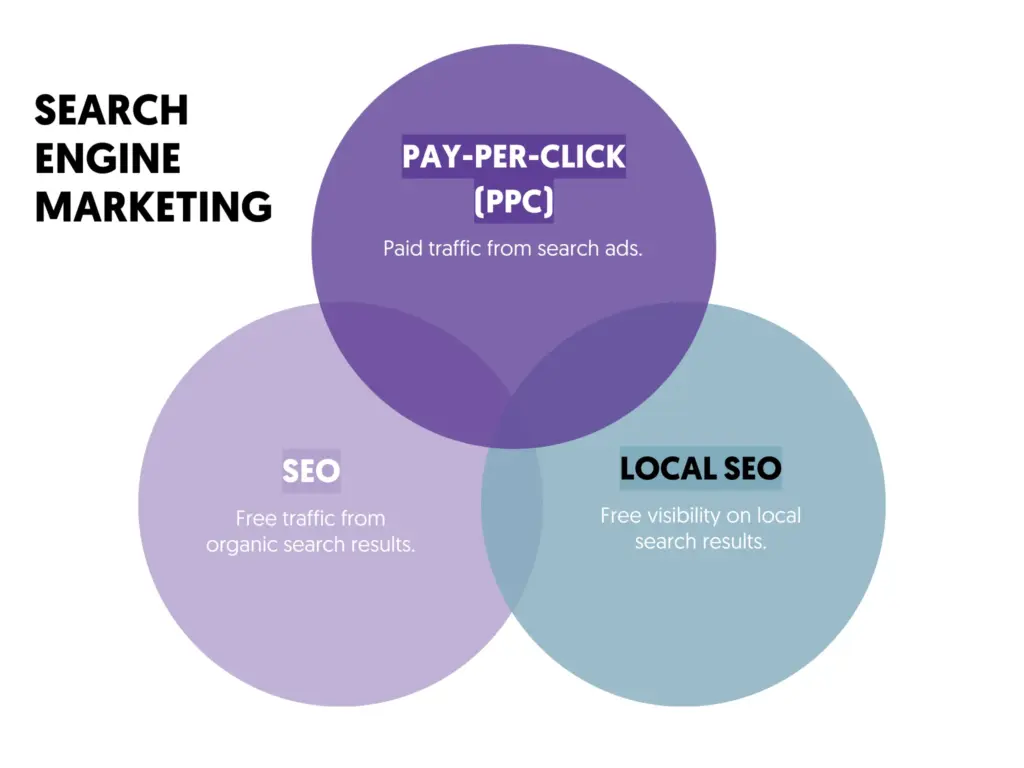
What is SEM?
SEM (Search Engine Marketing) is a digital marketing strategy that uses paid advertisements to increase a website’s visibility on search engine results pages (SERPs). Businesses bid on keywords, and their ads appear above or below organic search results.
The most popular SEM platform is Google Ads.
With SEM, businesses pay only when someone clicks on their advertisement. This model is called Pay-Per-Click (PPC).
Key Elements of SEM
1. Paid Search Ads
- Text ads displayed on Google search results.
- Shopping ads for e-commerce products.
- Call-only ads for businesses.
2. Keyword Bidding
- Businesses bid on keywords.
- Higher-quality ads and relevant landing pages can improve ad ranking.
3. Ad Copy
- Writing attractive headlines.
- Clear descriptions.
- Strong Call-to-Action (CTA).
4. Landing Pages
- Optimized pages where users arrive after clicking an ad.
- Designed to increase conversions.
Advantages of SEM
- Instant visibility.
- Immediate website traffic.
- Highly targeted audience.
- Easy to measure performance.
- Excellent for product launches and promotions.
Disadvantages of SEM
- Can become expensive.
- Traffic stops when the advertising budget ends.
- Requires regular campaign monitoring and optimization.
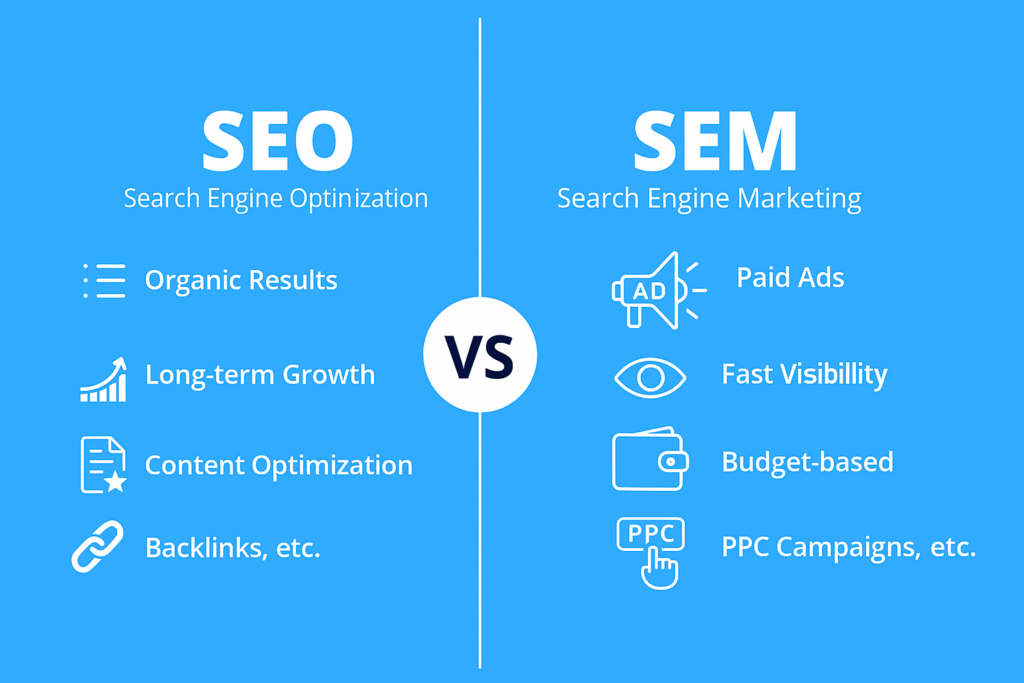
SEO vs SEM: Key Differences
| Feature | SEO | SEM |
|---|---|---|
| Full Form | Search Engine Optimization | Search Engine Marketing |
| Cost | Organic (No payment per click) | Paid advertisements |
| Results | Slow (3–6 months or longer) | Immediate |
| Traffic | Organic traffic | Paid traffic |
| Ranking | Based on optimization and relevance | Based on bids, ad quality, and relevance |
| Duration | Long-term benefits | Works while ads are running |
| ROI | Better over the long term | Faster but depends on budget |
| Trust | Higher user trust | Some users skip ads |
| Maintenance | Regular optimization | Daily campaign management |
When Should You Use SEO?
SEO is the best choice when:
- You want long-term website growth.
- You have time to build organic traffic.
- You want to reduce advertising costs.
- You want to build trust and authority.
- You regularly publish helpful content.
Example:
A digital marketing blog that wants consistent visitors every month should focus on SEO.
When Should You Use SEM?
SEM is ideal when:
- You need immediate traffic.
- You are launching a new product.
- You are running a limited-time offer.
- You want quick lead generation.
- You have an advertising budget.
Example:
An online clothing store launching a festive sale can use Google Ads to reach customers immediately.
Can SEO and SEM Work Together?
Yes. In fact, many successful businesses use both SEO and SEM as part of their digital marketing strategy.
For example:
- Use SEM to generate immediate traffic and sales.
- Use SEO to build long-term organic traffic and reduce future advertising costs.
- Use SEM data to identify high-performing keywords, then create SEO content around those keywords.
This combined strategy helps businesses achieve both short-term and long-term growth.
Which One is Better?
There is no single answer because the best choice depends on your business goals.
- If you want free, sustainable traffic and long-term growth, SEO is the better option.
- If you need quick results, instant leads, or fast sales, SEM is the better choice.
- For most businesses, the strongest strategy is to use SEO and SEM together. SEO builds a solid foundation, while SEM provides immediate visibility and supports marketing campaigns.
Conclusion
SEO and SEM are both powerful digital marketing strategies that help businesses increase their online visibility and attract customers through search engines. While SEO focuses on improving organic search rankings over time, SEM uses paid advertisements to generate immediate traffic and results.
Understanding the strengths and limitations of both approaches allows businesses to make informed decisions based on their goals, budget, and timeline. In today’s competitive digital landscape, combining SEO and SEM often delivers the best results—offering the speed of paid advertising alongside the long-term value of organic search. By using both effectively, businesses can maximize website traffic, improve conversions, and achieve sustainable online growth.